
MVP & Product Engineering
PWA, web, mobile, SaaS, APIs, portals, and product foundations for validated scopes.
Product engineering, AI, DevOps, cloud, managed applications, technical support, CRM, data, customer operations, and specialist augmentation for technology businesses.
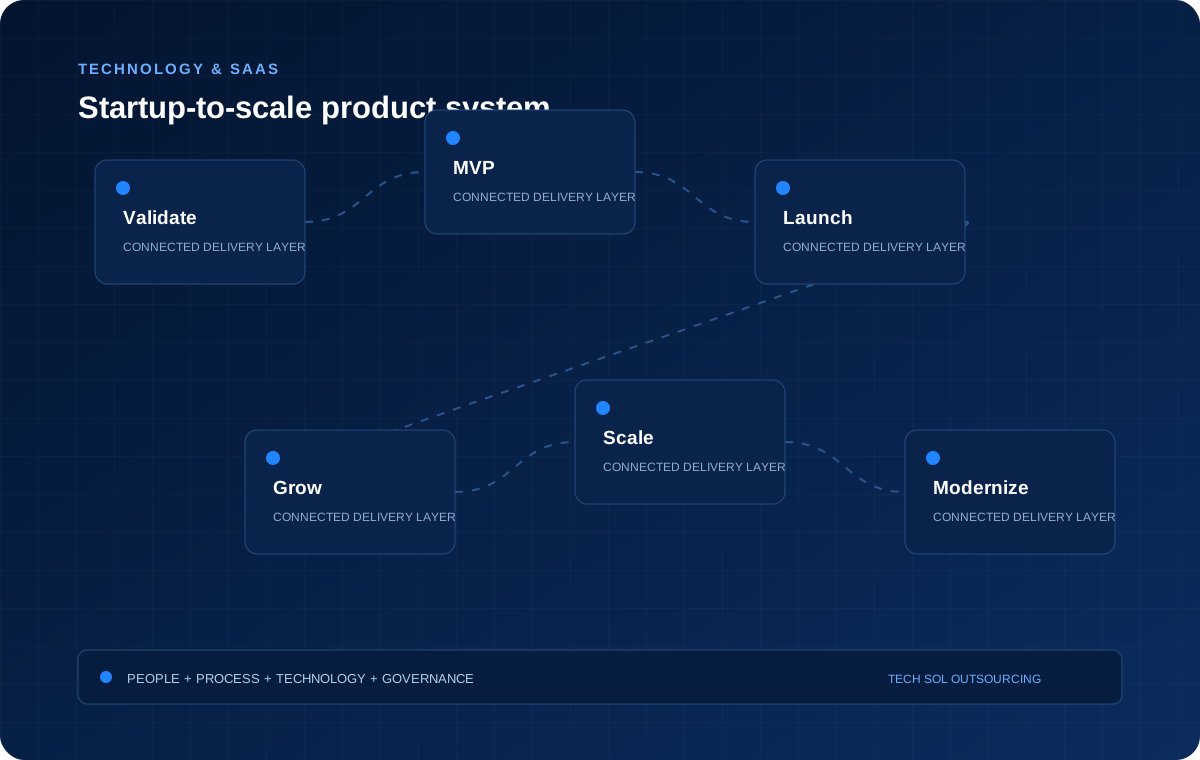
Each capability is defined as part of a larger delivery system. Scope can begin narrowly without pretending the neighboring dependencies do not exist.
PWA, web, mobile, SaaS, APIs, portals, and product foundations for validated scopes.
CI/CD, IaC, containers, Kubernetes, observability, SRE, cloud operations, and release engineering.
AI agents, ML, predictive analytics, data engineering, model deployment, and MLOps.
Application support, monitoring, maintenance, release coordination, and technical operations.
Onboarding, customer assistance, product support, documentation, and escalation workflows.
Lead, sales, lifecycle, automation, reporting, and customer data workflows.
Engineering, DevOps, AI/data, QA, design, support, and specialist roles added as needed.
Architecture, delivery, cloud, observability, security, and process improvements for growing systems.
Select a stage or solution type. The panel changes immediately, because interactivity should be visible rather than hiding somewhere below six screens of static cards.
Turn the business problem into users, journeys, assumptions, architecture constraints, and an evidence-based MVP scope.
Deliver the smallest coherent product that can test the workflow without building a disposable prototype.
Move from working software to production with monitoring, support paths, documentation, and operational readiness.
Expand features, automation, data, customer operations, and acquisition while controlling architecture and process debt.
Improve reliability, deployment, teams, cost, security, and product operations as complexity grows.
Refactor or replace high-risk constraints without performing a ceremonial rewrite of everything that still works.
Delivery quality depends on the interfaces between design, technology, people, controls, and operating responsibility.
User journeys, feature states, experience and product analytics.
Frontend, backend, APIs, services, integrations and data.
CI/CD, environments, cloud, infrastructure and release controls.
AI, automation, data pipelines, reporting and decision support.
Customer support, technical support, product administration and CRM.
Security, reliability, cost, teams, governance and continuous improvement.
The engagement moves from current-state understanding to architecture, controlled implementation, evidence-based verification, and an explicit operating handoff.
Inspect the current workflow, systems, dependencies, constraints, risks, and evidence.
Define target architecture, responsibilities, states, interfaces, acceptance criteria, and rollout.
Deliver controlled increments, keep working paths visible, and remove obsolete logic where replacement is required.
Test the real user path, document remaining risks, establish monitoring/support, then scale.
Technology and operational services need explicit proof standards, not decorative diagrams and the phrase “best practices” arranged tastefully around them.
An MVP can be small without being architecturally careless; the core should support learning and controlled evolution.
Monitoring, data protection, recovery, support, and release responsibility should exist before growth exposes every hidden shortcut.
Early products do not need enterprise complexity, but growing products should not remain trapped in assumptions from the prototype phase.
Product, DevOps, support, CRM, and data changes should share enough context that one team does not solve problems by creating them for another.
Most business systems cross product, infrastructure, data, people, and operations. These related practices can be combined without forcing a monolithic engagement.
Scope should become clearer before implementation starts, not after invoices and architectural archaeology have already accumulated.
Yes, particularly around scoping, MVP delivery, product experiments, architecture, and controlled release. The engagement should match the uncertainty level.
Yes, after a technical and operational audit establishes codebase, infrastructure, data, dependencies, security, release, monitoring, and support conditions.
Yes. Managed application, technical support, DevOps, customer operations, and augmentation can continue after initial delivery.
Yes. It is often better to establish data, workflow, and user needs first, then add AI where it produces measurable value.
Start with the current state, desired outcome, constraints, and systems already in place.
Share the workflow, product, infrastructure, or capacity requirement. When deployed with the configured Worker and D1 binding, this form submits securely to the website inquiry API.