
Staffing Services
Technology and business professionals aligned to an agreed role, skills profile, working model, and responsibility boundary.
Role-based staffing, virtual professionals, dedicated teams, specialist pods, and team augmentation across engineering, DevOps, AI/data, IT, growth, sales, and business operations.
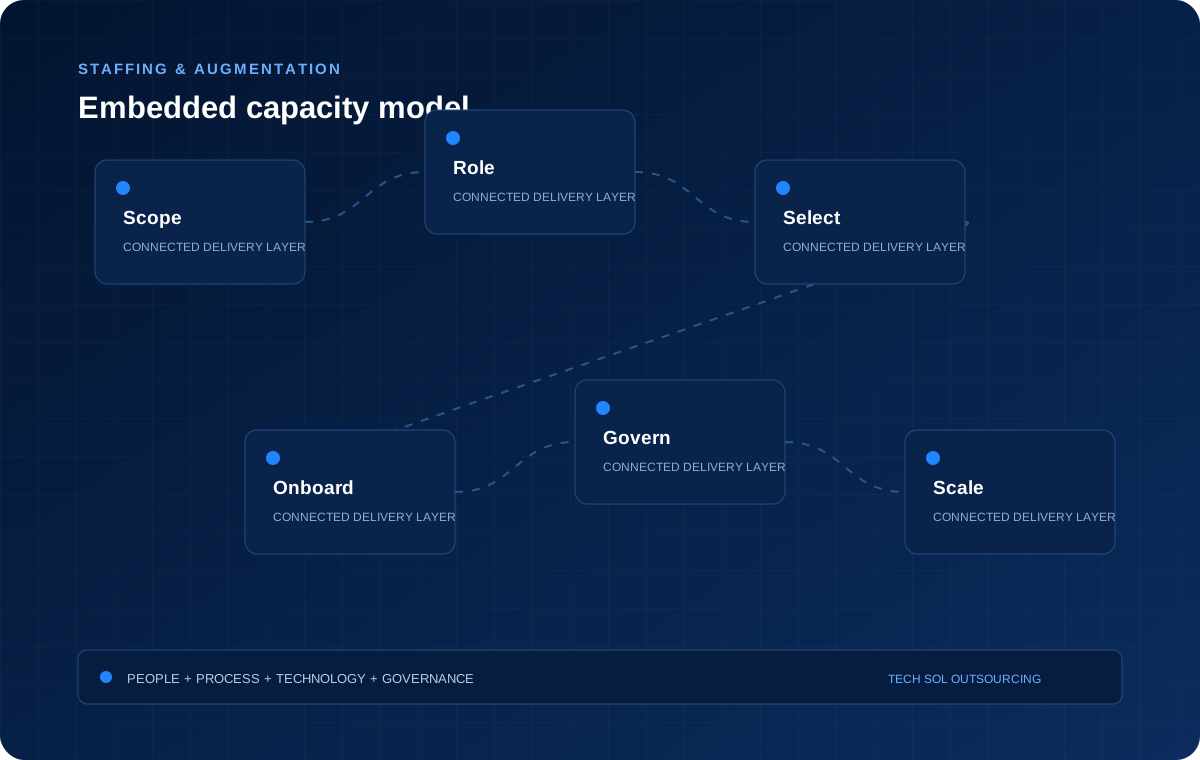
Each capability is defined as part of a larger delivery system. Scope can begin narrowly without pretending the neighboring dependencies do not exist.
Technology and business professionals aligned to an agreed role, skills profile, working model, and responsibility boundary.
Role-specific recruitment and placement based on job function, capabilities, tools, seniority, and operating context.
Remote professionals and virtual teams for ongoing business, technical, administrative, or growth support.
Specialists added to an existing client team while the client retains product/project leadership.
Small multi-role units aligned around a defined capability or outcome with agreed delivery governance.
Frontend, backend, full-stack, mobile, QA, product, UI/UX, and supporting engineering roles.
Cloud, DevOps, SRE, platform, data, AI/ML, MLOps, IT, support, security, and infrastructure capacity.
Sales support, marketing, SEO, paid media, CRM, customer support, VA, back office, and coordination roles.
This directory preserves the concrete services behind the broader capability map. Expand a group to review exactly what is included instead of relying on a decorative umbrella label.
Recruitment and placement of technology and business professionals.
Staffing based on specific job functions, skills, and professional roles.
Remote professionals and virtual teams for ongoing business support.
Adding specialized professionals to strengthen an existing client team.
Select a stage or solution type. The panel changes immediately, because interactivity should be visible rather than hiding somewhere below six screens of static cards.
A role or specialist primarily allocated to the client scope with defined reporting, tools, hours, and responsibilities.
Specialist capacity inserted into an existing client team while product/project ownership remains with the client.
A small combination of roles assembled around a defined capability such as product, DevOps, growth, or operations.
Remote ongoing business support across defined recurring tasks, systems, communication, and service windows.
Delivery quality depends on the interfaces between design, technology, people, controls, and operating responsibility.
Responsibilities, outcomes, tools, hours, authority and reporting line.
Skills, seniority, domain context, communication and required evidence.
Screening, evaluation, fit, availability and client review where applicable.
Access, documentation, workflow, security, expectations and first deliverables.
Performance, communication, QA, escalation, continuity and scope changes.
Add roles, change coverage, replace capacity, transfer knowledge, or close scope.
The engagement moves from current-state understanding to architecture, controlled implementation, evidence-based verification, and an explicit operating handoff.
Inspect the current workflow, systems, dependencies, constraints, risks, and evidence.
Define target architecture, responsibilities, states, interfaces, acceptance criteria, and rollout.
Deliver controlled increments, keep working paths visible, and remove obsolete logic where replacement is required.
Test the real user path, document remaining risks, establish monitoring/support, then scale.
Technology and operational services need explicit proof standards, not decorative diagrams and the phrase “best practices” arranged tastefully around them.
A staffing engagement fails quickly when the role description is a list of unrelated responsibilities with no decision ownership.
Technical and specialist roles should be evaluated against relevant capabilities rather than titles alone.
Access, documentation, communication rhythm, tools, and first deliverables should be prepared before capacity is expected to perform.
Knowledge, access, handover, replacement, and role transition responsibilities should be explicit.
Most business systems cross product, infrastructure, data, people, and operations. These related practices can be combined without forcing a monolithic engagement.
Scope should become clearer before implementation starts, not after invoices and architectural archaeology have already accumulated.
In staffing/augmentation, the client typically retains more day-to-day delivery ownership. In a managed service, Tech Sol owns a defined process or service outcome under an agreed operating model.
Yes, including software engineering, DevOps, cloud, AI/data, IT, support, and related specialist roles.
Yes. Capacity can evolve from one role to a multi-role pod if ownership, workload, interfaces, and governance are redesigned accordingly.
No unsupported talent-pool numbers are claimed. Availability depends on role, seniority, location/time-zone needs, skills, and engagement timing.
Start with the current state, desired outcome, constraints, and systems already in place.
Share the workflow, product, infrastructure, or capacity requirement. When deployed with the configured Worker and D1 binding, this form submits securely to the website inquiry API.