
Customer Support
Voice, email, chat, case handling, follow-up, escalation, documentation, and customer coordination.
Customer support, call center, telemarketing, technical support, sales support, back office, virtual assistance, dispatch, short-term rental operations, reporting, and workflow coordination.
Each capability is defined as part of a larger delivery system. Scope can begin narrowly without pretending the neighboring dependencies do not exist.
Voice, email, chat, case handling, follow-up, escalation, documentation, and customer coordination.
Inbound/outbound calling, telemarketing, lead generation, qualification, campaigns, and customer communication.
Customer and product-related technical assistance under documented escalation and knowledge workflows.
Lead response, qualification, follow-up, appointment coordination, CRM updates, and pipeline administration.
Administrative processing, records, data, reporting, coordination, documentation, and recurring workflows.
Role-based remote support for scheduling, research, CRM, communications, administration, and coordination.
Booking, scheduling, driver/field coordination, status handling, exception management, and reporting.
Guest communication, cleaner and maintenance coordination, issue tracking, service handoffs, and administrative support.
This directory preserves the concrete services behind the broader capability map. Expand a group to review exactly what is included instead of relying on a decorative umbrella label.
Outsourced operational and administrative business functions.
Inbound/outbound calling, telemarketing, lead generation, and customer communication.
Customized business-process support and operational outsourcing.
Customer and product-related technical assistance.
Select a stage or solution type. The panel changes immediately, because interactivity should be visible rather than hiding somewhere below six screens of static cards.
A managed customer-contact workflow with queue ownership, knowledge, escalation, QA, and reporting.
Lead response and outbound workflows built around qualification rules, cadence, disposition, CRM discipline, and handoff.
Recurring operational and administrative work with defined inputs, due states, approvals, exceptions, and outputs.
Tiered customer/product support with troubleshooting paths, knowledge, escalation to specialists, and issue evidence.
Time-sensitive coordination across bookings, drivers, guests, vendors, cleaners, maintenance, and operational exceptions.
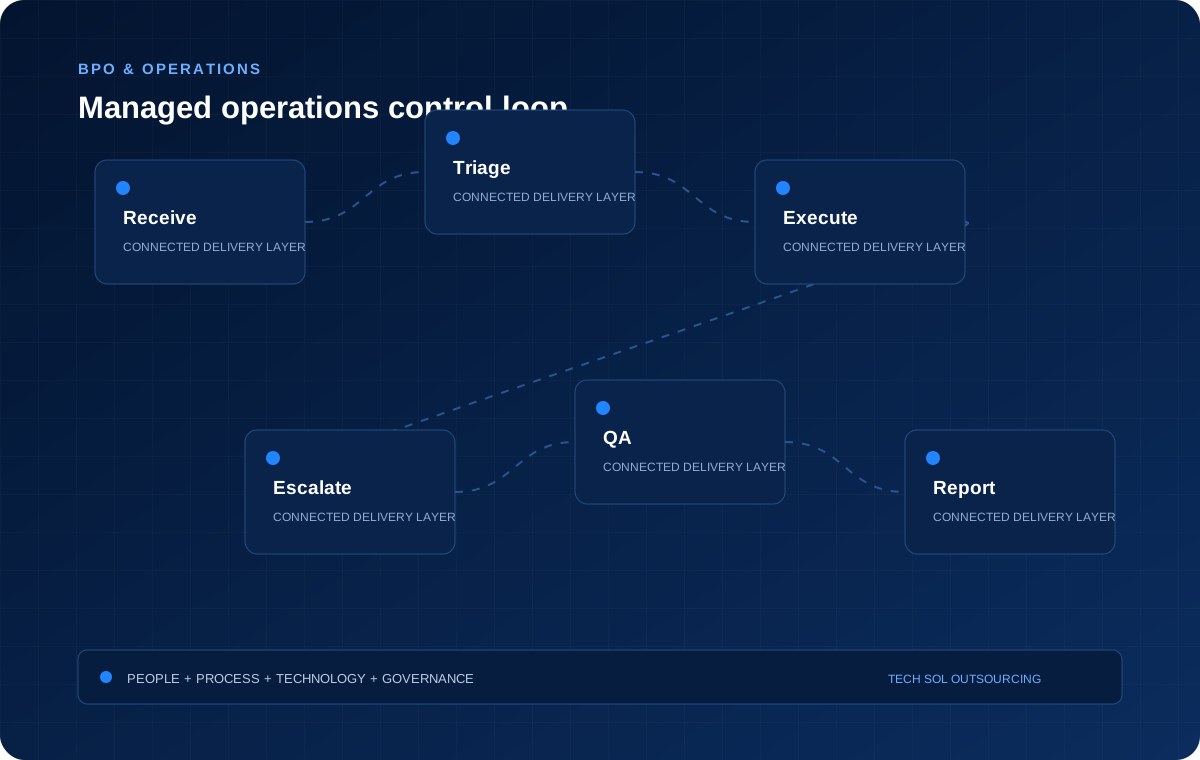
Delivery quality depends on the interfaces between design, technology, people, controls, and operating responsibility.
Channels, queues, lead sources, tasks, requests, and service events.
Priority, category, ownership, qualification, and service-level expectations.
Documented actions, communication, system updates, and coordination.
Defined exception paths for approval, risk, technical issues, or authority limits.
Sampling, accuracy, compliance, documentation, and coaching signals.
Volume, outcomes, aging, exceptions, quality, and improvement actions.
The engagement moves from current-state understanding to architecture, controlled implementation, evidence-based verification, and an explicit operating handoff.
Inspect the current workflow, systems, dependencies, constraints, risks, and evidence.
Define target architecture, responsibilities, states, interfaces, acceptance criteria, and rollout.
Deliver controlled increments, keep working paths visible, and remove obsolete logic where replacement is required.
Test the real user path, document remaining risks, establish monitoring/support, then scale.
Technology and operational services need explicit proof standards, not decorative diagrams and the phrase “best practices” arranged tastefully around them.
The team needs explicit authority, responsibilities, escalation paths, systems, and exceptions.
Customer, lead, property, dispatch, or administrative work should leave reliable records in the agreed system.
Quality checks should measure the actual workflow, not generic scorecards disconnected from the work.
Repeated exceptions, process delays, and system gaps should feed process and automation improvements.
Most business systems cross product, infrastructure, data, people, and operations. These related practices can be combined without forcing a monolithic engagement.
Scope should become clearer before implementation starts, not after invoices and architectural archaeology have already accumulated.
Yes. Starting with one clearly bounded workflow often makes ownership, training, QA, and performance easier to establish before expansion.
Yes, subject to access, security, and process fit. The operating workflow should define where records and updates belong.
CRM, automation, portals, reporting, and internal tools can be built around the same workflow the operational team executes.
Yes, but staffing and coverage changes should preserve knowledge, handoffs, workload assumptions, and agreed service responsibilities.
Start with the current state, desired outcome, constraints, and systems already in place.
Share the workflow, product, infrastructure, or capacity requirement. When deployed with the configured Worker and D1 binding, this form submits securely to the website inquiry API.