
AI Agents as a Service
Agents for customer engagement, qualification, workflow actions, CRM updates, and assisted conversion.
Business-focused AI agents, custom models, predictive analytics, NLP, data engineering, deployment, monitoring, governance, and retraining under one production lifecycle.
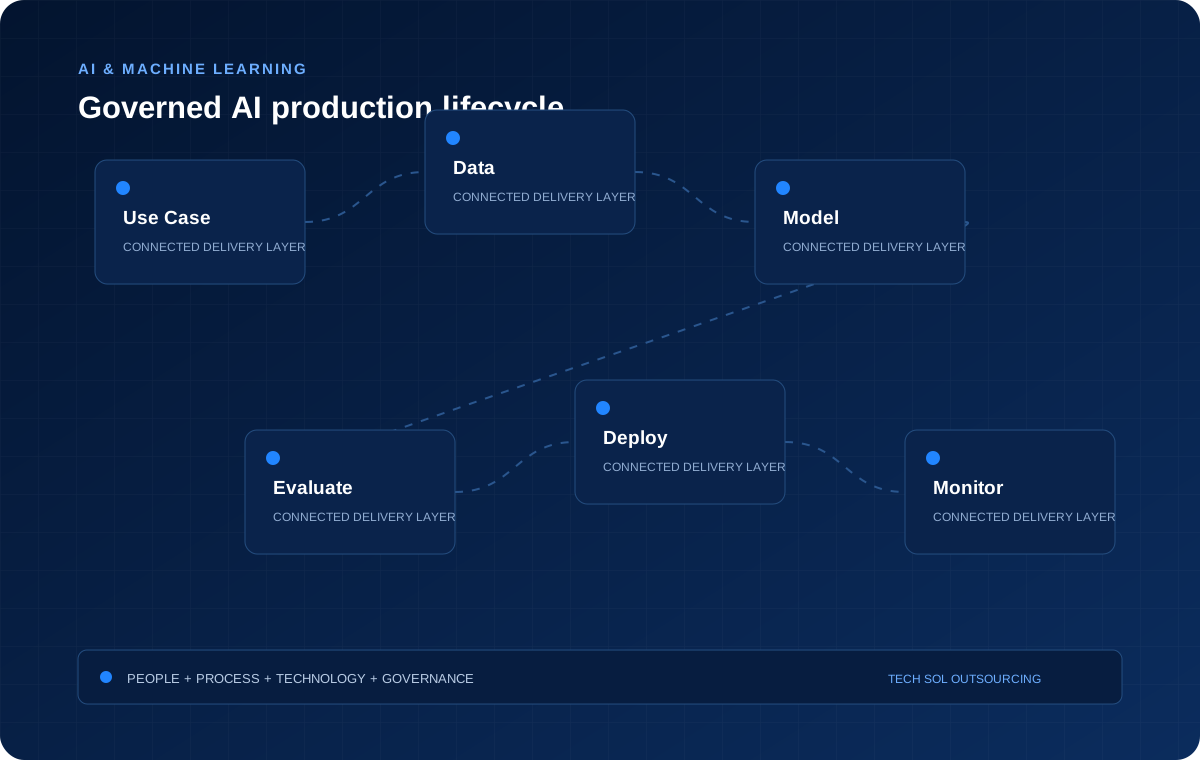
Each capability is defined as part of a larger delivery system. Scope can begin narrowly without pretending the neighboring dependencies do not exist.
Agents for customer engagement, qualification, workflow actions, CRM updates, and assisted conversion.
Predictive analytics, NLP, computer vision, optimization, and automation modules for defined business use cases.
AI strategy and implementation designed for larger workflows, governance requirements, and multiple systems.
Custom-built AI systems aligned to specific business data, processes, and output requirements.
Ingestion, transformation, pipelines, processing frameworks, and data management required for reliable AI.
Forecasting behaviors, trends, risks, demand, performance, and operational outcomes.
Chatbots, language workflows, sentiment, extraction, classification, and voice/language automation.
Deployment, monitoring, versioning, governance, reproducibility, retraining, and scaling.
This directory preserves the concrete services behind the broader capability map. Expand a group to review exactly what is included instead of relying on a decorative umbrella label.
Business-focused artificial intelligence and machine-learning solutions.
AI agents for customer engagement, lead qualification, workflows, CRM updates, and conversions.
Tailored AI modules for predictive analytics, computer vision, NLP, automation, and optimization.
Large-scale AI strategies and enterprise AI implementations.
Custom-built AI systems designed around specific business requirements.
Data pipelines, processing frameworks, ingestion, transformation, and data management.
Forecasting trends, risks, behaviors, and business outcomes.
Chatbots, sentiment analysis, voice systems, and language-based automation.
Automated model selection, training, optimization, and deployment.
Production deployment, performance tracking, scaling, and reliability monitoring.
Model control, transparency, reproducibility, compliance, and governance.
Continuous model updates and maintenance using fresh data.
Select a stage or solution type. The panel changes immediately, because interactivity should be visible rather than hiding somewhere below six screens of static cards.
Agent systems that combine conversational interfaces, business knowledge, tool actions, guardrails, and human handoff.
Models designed around measurable business outcomes rather than generic predictions.
Language systems for understanding, generating, extracting, classifying, and routing unstructured information.
Visual intelligence for classification, detection, document/image understanding, and defined operational use cases.
Multi-system AI programs with data boundaries, governance, observability, permissions, and change control.
The production layer that keeps models deployable, observable, versioned, repeatable, and maintainable.
Delivery quality depends on the interfaces between design, technology, people, controls, and operating responsibility.
Define business decision, workflow, data, failure cost, and human role.
Collect, validate, transform, secure, and govern the data path.
Select, train, configure, or orchestrate the appropriate AI approach.
Test accuracy, behavior, edge cases, safety, and business acceptance criteria.
Productionize APIs, services, agent tools, scaling, and access controls.
Monitor quality, drift, incidents, costs, versions, and retraining.
The engagement moves from current-state understanding to architecture, controlled implementation, evidence-based verification, and an explicit operating handoff.
Inspect the current workflow, systems, dependencies, constraints, risks, and evidence.
Define target architecture, responsibilities, states, interfaces, acceptance criteria, and rollout.
Deliver controlled increments, keep working paths visible, and remove obsolete logic where replacement is required.
Test the real user path, document remaining risks, establish monitoring/support, then scale.
Technology and operational services need explicit proof standards, not decorative diagrams and the phrase “best practices” arranged tastefully around them.
High-impact or ambiguous workflows can preserve explicit human review and escalation paths.
Model versions, prompts/configuration, data transformations, evaluation results, and production changes should be reproducible.
Quality, latency, cost, drift, failures, and business outcomes need production signals.
Access, retention, permissions, and sensitive-data handling are part of the architecture rather than an afterthought.
Most business systems cross product, infrastructure, data, people, and operations. These related practices can be combined without forcing a monolithic engagement.
Scope should become clearer before implementation starts, not after invoices and architectural archaeology have already accumulated.
No. The right approach may be an agent using an existing model, a retrieval system, classical ML, a custom model, or a combination.
Yes, where the CRM exposes appropriate APIs or supported integrations and the action is governed with validation and permissions.
By defining evaluation criteria, logging relevant decisions/actions, versioning configuration, monitoring behavior, and preserving human review where required.
Yes, when data quality, evaluation gates, rollback rules, and governance support safe automated retraining.
Start with the current state, desired outcome, constraints, and systems already in place.
Share the workflow, product, infrastructure, or capacity requirement. When deployed with the configured Worker and D1 binding, this form submits securely to the website inquiry API.